History / 01
The history of GTA: how a city became the main character
The series did more than make its maps bigger. It kept changing what a player could do with a city.
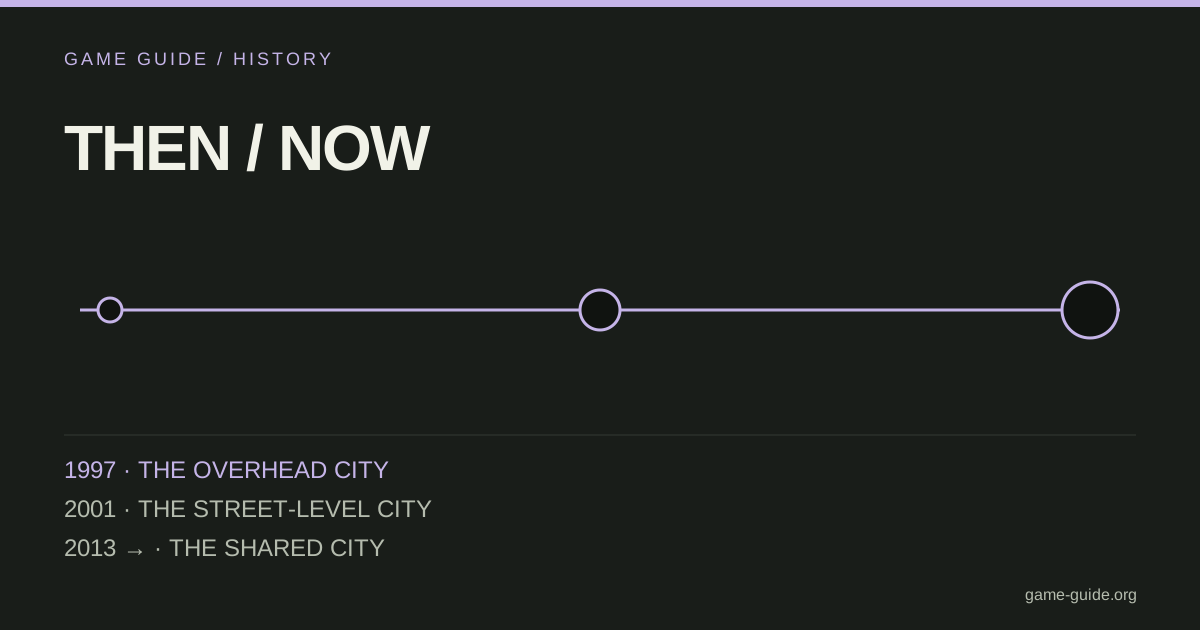
01 / History
A timeline of turning points
This is a selective history of major releases and changes, not a list of every port, expansion or handheld game. Years below identify the original release unless marked otherwise. A later PC edition is not the birth date of the game.
The original GTA is a useful example of why dates need context. Take-Two’s historical filing lists an international release in November 1997 and a North American release in June 1998. “GTA began in 1997” and a later US release can both be true.
| Year | Milestone | What to notice |
|---|---|---|
| 1997 | Grand Theft Auto | An overhead view makes the street network readable as a playground. |
| 1999 | GTA 2 | Gang reputation gives actions consequences beyond the immediate chase. |
| 2001 | GTA III | The city becomes a fully 3D space to navigate at street level. |
| 2002 | Vice City | A distinct 1980s identity connects setting, music and criminal ambition. |
| 2004 | San Andreas | CJ’s journey expands the scale from a city to a state. |
| 2008 | GTA IV | Niko Bellic’s arrival reframes Liberty City through an outsider’s hopes. |
| 2013 | GTA V / GTA Online | Three interwoven leads; a separate online launch later that year. |
| 2021 | The Trilogy – The Definitive Edition | Older works return in a new technical presentation. |
| 2026, scheduled | GTA VI | Rockstar lists November 19; an announced release is not a completed launch. |
Sources: Take-Two · 1999 annual filing · Rockstar · GTA 2 · Rockstar · The Trilogy launch, November 11, 2021 · Rockstar · Vice City development retrospective · Take-Two · fiscal 2004 results · Rockstar · Grand Theft Auto IV · Take-Two · fiscal 2014 filing · Rockstar · GTA VI
02 / History
The first change: getting inside the city
An overhead street plan lets you see intersections, traffic and routes at once. Moving the camera down into a 3D world changes the problem: distance, landmarks and sightlines now have to help you find your way. GTA III’s significance is easier to understand through that change than through a simple “better graphics” story.
Developers reflecting on GTA III for PlayStation’s twentieth-anniversary feature describe the appeal of unscripted situations as well as missions. That distinction matters. A mission supplies a destination; a crowded, reactive city makes the journey produce stories of its own.
Our reading is that the durable idea was the relationship between authored objectives and player improvisation. A map can be large and still feel inert. A small encounter can feel expansive when the player has several ways to respond.
03 / History
The second change: giving each place an identity
Vice City and San Andreas make a useful pair. The former centers Tommy Vercetti’s rise in a stylized 1980s city; the latter follows CJ’s return home and a journey through a broader state. These are different dramatic frames, not interchangeable backdrops with new road layouts.
For a new reader, this explains why release order and story setting should be kept separate. A later game can look backward to an earlier cultural moment. Playing in release order reveals design changes; choosing a setting follows a different, equally reasonable curiosity.
The numbered games alone are not the entire series. London, Advance, Liberty City Stories, Vice City Stories and Chinatown Wars also belong in a fuller history. This introductory timeline keeps its scope narrow so that ports and side stories do not get mistaken for numbered sequels.
Sources: Rockstar on Steam · Vice City · Rockstar on Steam · San Andreas
04 / History
The third change: the city persists
Take-Two’s release table separates GTA V on September 17, 2013 from GTA Online on October 1. That small distinction opens a much larger question: what changes when a game is also a place people keep returning to?
The answer is partly editorial. A review of a fixed campaign describes one work; advice about an evolving online world needs a platform, version and date. An old article can be historically accurate while being poor current buying advice.
GTA VI is the next focal point, but it should not flatten the past into a countdown. The older games are useful comparisons because they tried different balances of atmosphere, character, scope and freedom. Start with our games comparison if you want to choose one, or the development explainer if you want to understand the work behind those changes.
Sources: Take-Two · fiscal 2014 filing
Evidence / Read the originals
Sources & scope
Sources checked November 17, 2026. Explanations and recommendations are Game Guide’s editorial interpretation. Historical announcements describe their own dates; changing details need a current check.
- Take-Two · 1999 annual filing ↗
Original GTA international/US release windows; GTA 2 business context.
- Rockstar · GTA 2 ↗
1999 release and gang-reputation premise.
- Rockstar · The Trilogy launch, November 11, 2021 ↗
The three included games and the 2001 release of GTA III. Future dates in this historical announcement are not treated as actual releases.
- Rockstar · Vice City development retrospective ↗
Retrospective linking interviews with Rockstar North, including art director Aaron Garbut.
- Take-Two · fiscal 2004 results ↗
Confirms San Andreas released in late October 2004.
- Rockstar · Grand Theft Auto IV ↗
Niko Bellic, Liberty City and April 29, 2008 release.
- Take-Two · fiscal 2014 filing ↗
GTA V and GTA Online are listed with separate September and October 2013 release dates.
- Rockstar · GTA VI ↗
Current announced release, platforms, protagonists and setting.
- PlayStation Blog · developers remember GTA III ↗
First-person recollections from developers across several studios, November 2, 2021.
- Rockstar on Steam · Vice City ↗
Tommy Vercetti, 1980s setting and remaster description. Store tags and user reviews are not editorial evidence.
- Rockstar on Steam · San Andreas ↗
CJ, the early-1990s setting and the state-wide journey.